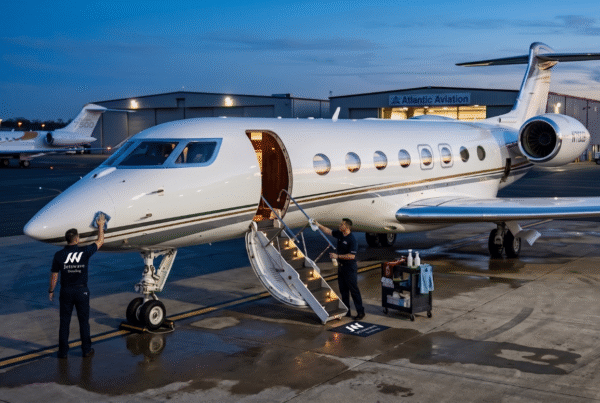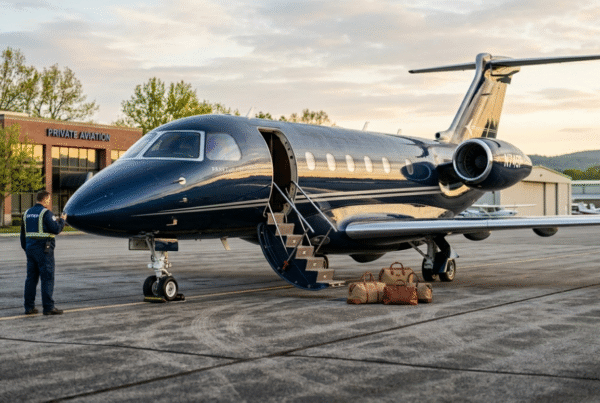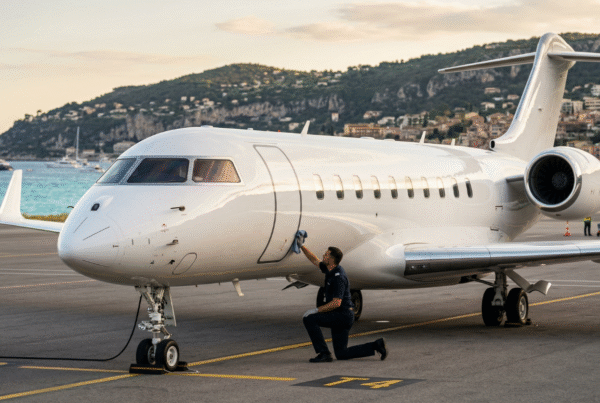


May 12 to May 23, 2026. La Croisette, Cannes. The Palais des Festivals. Twelve days in which the most scrutinized, most photographed, and most image-conscious gathering in global culture takes place three kilometers from the Mediterranean coastline and roughly fifty minutes by road from Nice Côte d’Azur Airport (LFMN).
The 79th Cannes Film Festival is already drawing its passenger profile into focus. Park Chan-wook – director of Oldboy, The Handmaiden, and Decision to Leave – presides over the main jury. Honorary Palmes d’Or go to Peter Jackson and Barbra Streisand. The competition slate has just been revealed, with Asghar Farhadi, Pedro Almodóvar, Hirokazu Kore-eda, and Ryusuke Hamaguchi among those bringing films to the main competition. The opening night film is Pierre Salvadori’s The Electric Kiss, a 1920s romantic comedy hosted by French actress Eye Haïdara. The talent infrastructure behind this event – studios, distributors, producers, talent agencies, and the ownership groups that fund all of the above – moves almost entirely on private aircraft.
For Northeast US owners and operators preparing for the Cannes window, this post addresses one specific question: what does a VIP-caliber private jet interior actually require before it boards the passengers this event demands? Because if there is any event on the global private aviation calendar where interior presentation is not cosmetic – where the cabin is a direct extension of the brand, the relationship, and the client’s experience – it is Cannes.
The flight from Teterboro, JFK, or East Hampton to Nice is a transatlantic crossing of approximately 3,600 to 3,900 miles depending on hub and routing. It is a seven-to-eight-hour flight. The interior your passengers board in New Jersey or New York is the interior they will sit in for that entire crossing. And the standard they will carry from that cabin onto La Croisette is the standard you either set or failed to set on the ground before departure.
This is what VIP private jet interior detailing for Cannes 2026 actually looks like.
Why Cannes 2026 Sets a Different Standard for Private Jet Presentation
The 79th Edition and the Passengers It Will Move
Every Cannes Film Festival generates extraordinary private aviation volume around Nice Côte d’Azur Airport. The 79th edition, running May 12-23, is no different – but the specific profile of this year’s festival matters for understanding the passenger type Northeast operators are preparing for.
This edition trends heavily toward international auteur cinema rather than major Hollywood productions. The competition slate includes films from Japan, Iran, Spain, Poland, France, and the United States, with jury president Park Chan-wook bringing a Korean cinema sensibility to the selection process alongside competition entries from Hirokazu Kore-eda and Ryusuke Hamaguchi. The practical implication for private aviation is a festival disproportionately attended by international distribution executives, independent production financiers, and global talent representation – precisely the passenger profile that values discretion, attention to interior detail, and a cabin environment that signals sophistication without announcement.
These are not passengers who need a branded experience. They need an experience that is correct in every dimension without requiring them to notice it. That starts with a cabin that has been prepared – properly, completely, and by people who understand what VIP preparation actually means for a seven-plus-hour transatlantic crossing.
Honorary Palmes d’Or to Peter Jackson and Barbra Streisand signal additional high-profile attendance. John Travolta’s directorial debut is screening in the Cannes Premiere section. The talent-facing dimension of this festival – agents, managers, publicists, and studio executives coordinating talent movement to and from the Croisette – adds a specific charter and managed-fleet demand layer that Northeast operators with Part 135 authorizations will recognize from previous Cannes cycles.
Nice Côte d’Azur Airport and the Northeast US Connection
Nice Côte d’Azur Airport (LFMN, IATA: NCE) is the primary arrival point for private aviation into Cannes. The airport operates two terminals, with private and business aviation handled through Signature Flight Support and other handlers with strong connectivity into the Cannes FBO ecosystem. Ground transfers to La Croisette take approximately 40 to 55 minutes depending on traffic and vehicle type.
For Northeast US owners, the routing options are well-established. Aircraft from Teterboro (KTEB) and Morristown (KMMU) operate non-stop to LFMN on large-cabin, long-range platforms – Gulfstream G700, Bombardier Global 8000, Dassault Falcon 8X – with fuel stops typically unnecessary at range. JFK-based aircraft follow similar routing. For Hamptons-area owners, East Hampton Airport (KHTO) positions for departure to LFMN with a transit to a larger nearby hub or, for aircraft with sufficient range, directly.
The Cannes window creates compressed arrival and departure traffic at LFMN across the May 12-23 period, with peak inbound activity in the May 10-14 opening week and peak outbound in the May 22-24 closing window. Northeast owners positioning aircraft for the festival typically plan arrivals on May 10 or 11, allowing for a day of European ground time before the opening ceremony on May 12.
Working backward from a May 10-11 departure from the Northeast, the pre-departure service window runs May 1-8 – exactly the period that coincides with this post’s publish date.
The VIP Interior Detailing Standard: What Cannes-Caliber Preparation Actually Means
Leather Care and Conditioning: The Foundation of Every VIP Cabin
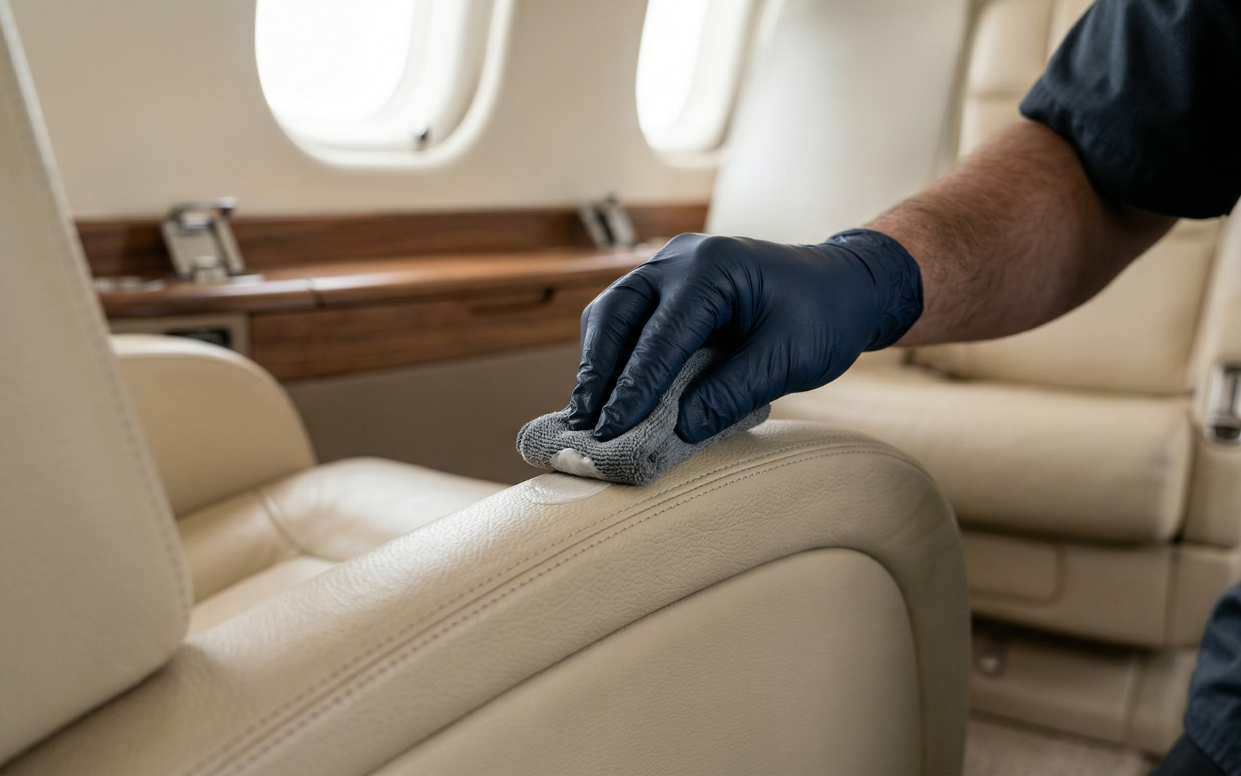
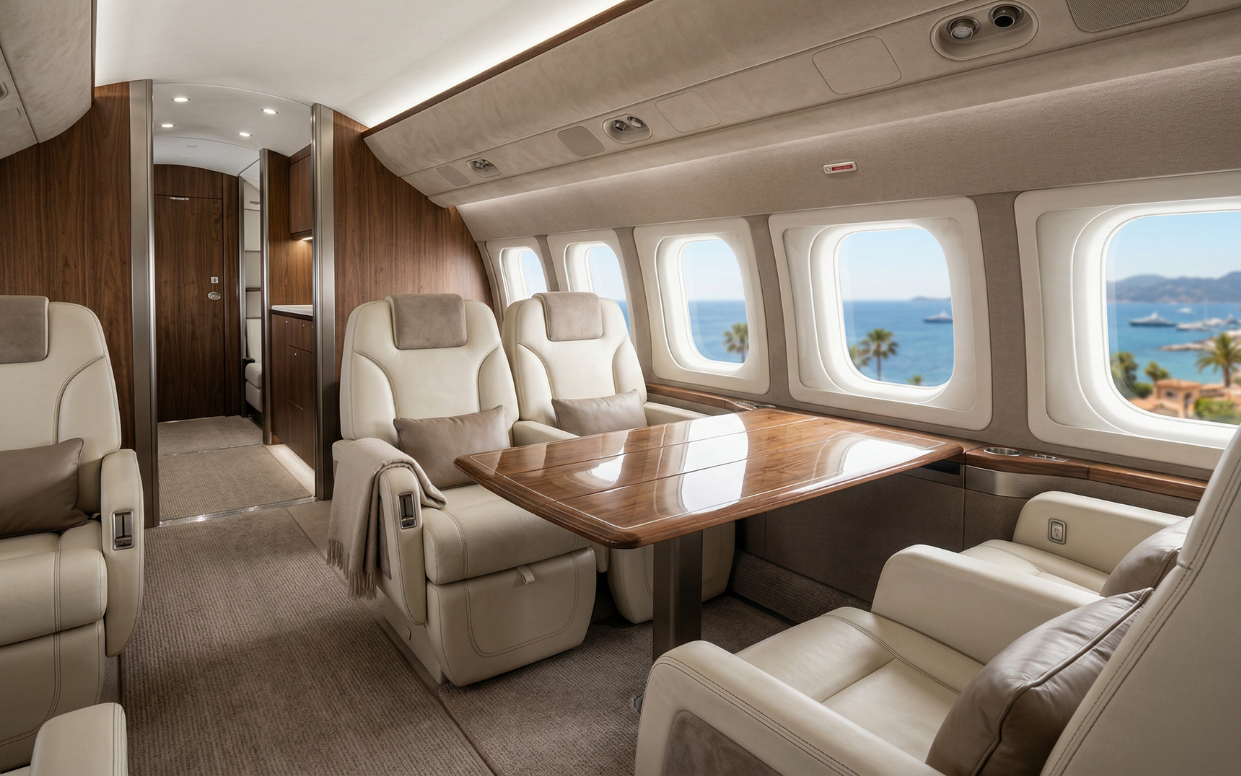
If there is one material that defines the interior standard of an ultra-long-range private aircraft cabin – and the one that most visibly telegraphs whether a cabin has been properly maintained – it is leather. The main cabin seating of a Gulfstream G700, Bombardier Global 8000, or Dassault Falcon 8X is built around full-grain leather that represents tens of thousands of dollars in upholstery investment per aircraft. It is also the surface your VIP passengers will be in contact with for the entire seven-to-eight-hour crossing.
Leather that has dried, cracked at the bolsters, developed surface oxidation, or carries residual odor from previous trips does not present as a minor imperfection at altitude – it presents as the defining sensory condition of the cabin. Professional leather conditioning is not a finishing detail for VIP preparation. It is the foundation.
Full-Grain Leather vs. Alcantara: Different Materials, Different Protocols
The interior material specification of luxury long-range aircraft cabins varies by manufacturer, configuration, and completion center. While full-grain leather dominates main cabin seating across most Gulfstream, Bombardier, and Dassault platforms, Alcantara – a microfiber suede material used in headliners, ceiling panels, accent surfaces, and some armrest inserts – requires an entirely different cleaning and conditioning protocol.
Alcantara’s tight microfiber structure is unforgiving of incorrect product application. Silicone-based conditioners, solvent cleaners, and anything with an oil carrier will mat the fibers, create surface sheen, and in some cases permanently alter the material’s texture. Professional interior detailing services that work on ultra-long-range cabin platforms know this distinction without being told. Services that don’t know it discover it at your expense.
Jetswave’s interior protocols are aircraft-specific and material-specific for precisely this reason. The product selection and application method for Alcantara headliner panels on a Dassault Falcon 8X is different from the conditioning treatment for the full-grain leather club seating in its main cabin – and both are different from the treatment appropriate for the synthetic leather used in some aft lavatories and galley surfaces.
Pre-Flight Conditioning for Long-Haul International Legs
Transatlantic flights create specific leather stress conditions that domestic flights do not. Sustained low cabin humidity at altitude, combined with seven-to-eight hours of continuous seat occupation, places higher demand on leather hydration and surface condition than a 90-minute domestic positioning leg. Leather that was adequately conditioned three months ago for domestic travel may not meet the same standard for a Cannes crossing.
Pre-flight conditioning at this level is a three-stage process: surface cleaning to remove accumulated skin oils, dust, and any product residue from previous treatment; conditioner application at appropriate concentration for the leather grade and age; and buffing to a consistent finish that neither leaves product transfer on passengers’ clothing nor creates a reflective sheen inconsistent with the cabin’s visual standard.
For aircraft that have not received leather service within the past 60 days, this process takes time and should not be rushed into the 48-hour pre-departure window. The 14-to-7-day service slot is the correct timing for full leather conditioning before a transatlantic VIP crossing.
Carpet and Upholstery: Deep-Extraction Standards for Film Industry Clients
The carpet specification in a large-cabin private aircraft is significantly higher grade than commercial aviation carpet – custom Axminster or tufted wool in most Gulfstream, Bombardier, and Dassault completions – and it reflects the wear and contamination of its previous use in ways that surface vacuuming alone does not address.
Deep-extraction carpet cleaning uses hot water extraction under controlled temperature and pressure to lift embedded particulate, protein contamination from food service, and residual liquid penetration from spilled beverages that surface cleaning does not reach. For aircraft that carry frequent catering – and any aircraft managed for film industry clients during festival season will carry frequent catering – deep extraction is the standard, not the premium upgrade.
Post-extraction, professional deodorization treatment addresses any residual organic odor compounds in the carpet substrate. This is particularly relevant in aircraft that have carried food service catering recently, where aromatic compounds from previous meals can resurface in the warm, recirculated air of a long-haul cabin environment.
The Complete Interior Detailing Scope for a Cannes-Bound Aircraft
Headliner, Sidewall, and Surface Panel Cleaning
Headliner and sidewall panels are among the least-frequently serviced surfaces in a private aircraft interior – and among the most visually prominent when passengers are seated in full-recline position during a long-haul flight. Fabric headliners in particular accumulate fine particulate, hair transfer, and light soiling from routine use that becomes visible against overhead lighting during extended flight.
Professional headliner cleaning for transatlantic preparation uses low-moisture foam-based cleaning appropriate for the substrate, avoiding over-wetting that can affect the adhesive bonding of headliner panels or create water marks in porous fabric surfaces. Sidewall panels – typically leather-wrapped or Alcantara in large-cabin completions – receive the same material-specific treatment as main cabin seating.
Window surround surfaces, seatback tray table mechanisms, and all interior trim pieces including metal accents, woodwork veneers, and vent surrounds are cleaned and brought to a consistent surface standard as part of the full interior scope.
Galley Deep Clean Before Catering and Service
The galley of a large-cabin transatlantic aircraft is a working production space for a seven-to-eight-hour flight service. It is also one of the most contamination-prone surfaces in the aircraft – hidden drawer tracks, cabinetry hinges, under-counter surfaces, and chiller seals accumulate grease, food protein, and moisture that standard cleaning does not fully address.
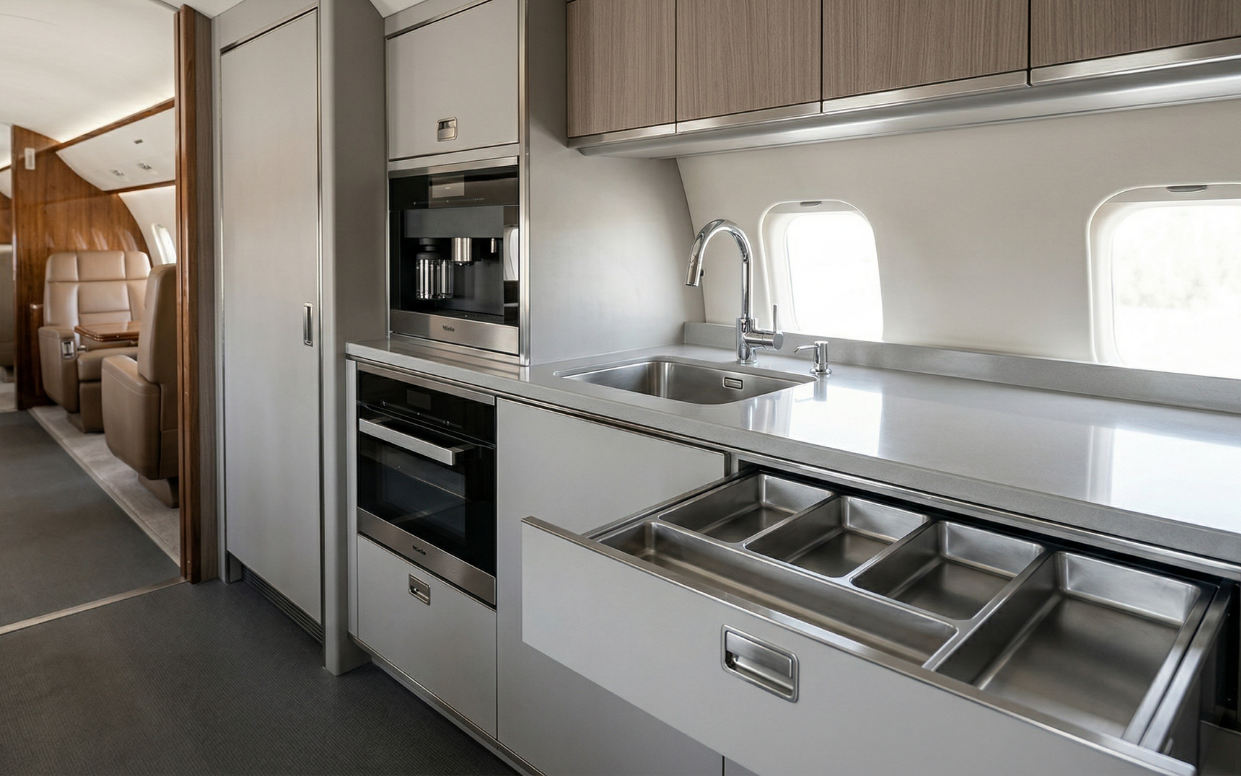
Pre-flight galley deep clean for a Cannes-caliber service standard addresses all cabinetry interiors and exteriors, drawer track cleaning, counter surface sanitation, chiller and warming drawer interior cleaning, faucet and sink fixture polishing, and trash compactor or waste system deodorization. The galley your caterer loads is not just a service surface – it is the environment that affects the odor profile of the entire forward cabin for the duration of the flight.
For aircraft carrying bespoke catering packages – which is the standard for the clientele attending a Cannes film festival – the galley condition on departure represents a direct input into the quality of the service experience your passengers receive. Starting with a properly deep-cleaned galley is non-negotiable.
Lavatory Sanitization for International Flights
The lavatory on a seven-to-eight-hour transatlantic flight receives usage volume proportional to its crossing time. A lavatory that was surface-cleaned before a previous shorter trip carries contamination residue in fixture seals, drain surrounds, cabinetry corners, and mirror mounting edges that compounds over a long flight.
Comprehensive lavatory sanitization for international preparation includes full fixture cleaning including faucets, sink basin, and drain; mirror and mirror surround cleaning; cabinetry interior and exterior cleaning; toilet fixture deep sanitation including all sealing surfaces; floor cleaning including seal edges and corner joins; and surface deodorization. For lavatories with Alcantara or specialty fabric wall panels, material-specific cleaning applies here as well.
Window Polishing and Glass Treatment for the Riviera Arrival
Private aircraft windows accumulate exterior contamination in flight – atmospheric particulate, salt haze at coastal departure hubs, and oxidation haze – and interior contamination from fingerprints, breath condensation, and cleaning product residue from previous service. On a flight approaching the French Riviera coastline over the Mediterranean on a clear May morning, those windows are the passenger’s view of one of the most visually dramatic arrival approaches in European aviation.
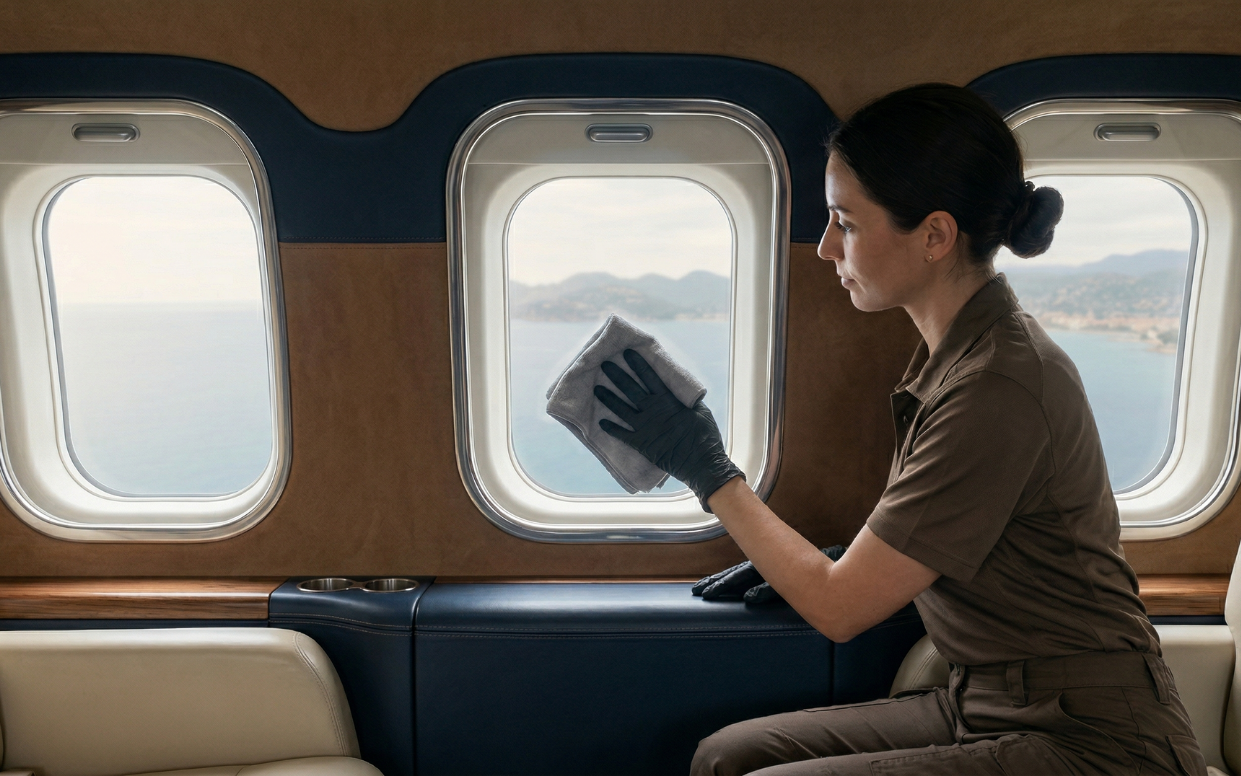
Professional interior window polishing uses optical-grade glass cleaners and lint-free microfiber application to remove interior haze and fingerprints without leaving product residue or lint transfer visible against direct light. Exterior window treatment – addressed as part of the exterior service scope – completes the visual standard from both sides of the glass.
How Jetswave Detailing Prepares Northeast Cabins for VIP European Travel
Aircraft-Specific Interior Protocols: G700, Global 8000, and Falcon 8X
The three platforms most frequently flown on the Northeast-to-Nice transatlantic route represent three distinct interior design philosophies and three distinct material specifications.
The Gulfstream G700 – the flagship of the Gulfstream line and one of the most capable ultra-long-range platforms in current production – features a cabin certified to a 4,500-foot cabin altitude at cruise, with natural lighting panels, full-cabin connectivity, and seating configurations that vary significantly by completion. Jetswave’s G700 interior protocol is calibrated to the specific leather grades, Alcantara application areas, and woodwork veneer specifications common across G700 completions.
The Bombardier Global 8000, with its Nuage seating system and bespoke cabin design options, presents a different material specification challenge – particularly in aircraft with mixed leather and fabric seating configurations, specialty headliner treatments, and the Global’s characteristic wide-cabin layout that creates larger surface areas in both the forward and aft cabin zones.
The Dassault Falcon 8X, while slightly smaller in cabin footprint than the G700 or Global 8000, is a common choice for Teterboro-based operators on the LFMN route given its 6,450-nautical-mile range and operational flexibility. Its cabin materials and finishing specifications reflect Dassault’s French completion tradition – precise, refined, and requiring product-appropriate care across leather, woodwork, and fabric surfaces.
Cabin Odor Removal and Fragrance Preparation
Cabin odor is the interior detail that no amount of visual cleaning addresses if it is not specifically treated. For a seven-to-eight-hour transatlantic crossing, any residual odor in the carpet, galley, or lavatory will become perceptible in the recirculated cabin air within the first two hours of flight.
Professional cabin odor removal for VIP preparation uses ozone treatment or enzyme-based deodorization depending on the odor source and severity. Ozone treatment – conducted with the aircraft empty and sealed – eliminates organic odor compounds at the molecular level without leaving fragrance residue. Enzyme-based treatment addresses specific localized sources such as galley contamination or carpet absorption from previous food service.
For Cannes-bound aircraft, the appropriate finishing note after odor treatment is neutral – clean air, no artificial fragrance, no residual cleaning product scent. The cabin’s fragrance profile on departure should be a non-factor. Any scent that passengers notice is either a problem that wasn’t addressed or a product that was applied incorrectly.
FBO Coordination at Teterboro, JFK, and East Hampton
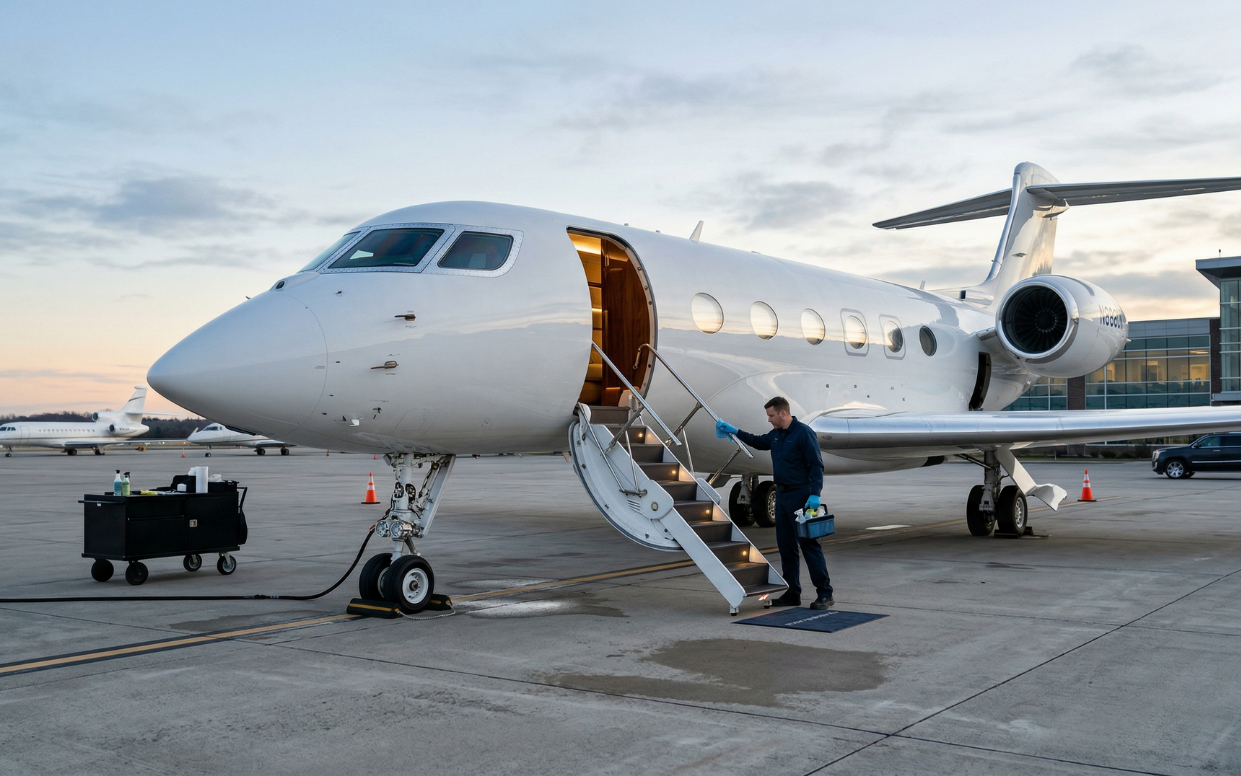
Jetswave coordinates mobile service access at all Northeast FBOs without requiring the flight department or owner to manage the logistics. At Teterboro – the primary hub for most Northeast-based large-cabin international departures – ramp access coordination for a mobile detailing vehicle is handled in advance with the relevant line service team.
At JFK’s private aviation facilities – including Signature and Million Air – similar coordination protocols apply. For East Hampton Airport (KHTO), where Hamptons-based ownership groups position aircraft ahead of European festival departures, mobile service access is arranged directly with East Hampton ground handling in advance of the service appointment.
For owners whose aircraft are currently positioned at a hub other than their typical departure point – a common scenario during the busy May window, when aircraft may be positioned at Morristown or White Plains after a domestic trip – Jetswave confirms service location as part of the initial booking call. Mobile service goes to where the aircraft is, not where it normally lives.
Booking Your Pre-Cannes Interior Detail: What May Looks Like for Northeast Owners
The May 1-10 Service Window and Why It Matters
The Cannes Film Festival opens May 12. Most Northeast departures position for Nice on May 9-11, with the earliest Cannes-bound aircraft wheels-up by May 8 for owners with pre-festival business in Europe. Working backward from a May 8-11 departure, the pre-departure interior service window is May 1-8 – and it is compressing now.
The Cannes window overlaps with the final leg of the UCL semi-final schedule (April 28/29 and May 5/6) and precedes the UCL Final departure window by just two weeks. May is one of the single busiest months in the Northeast private aviation calendar, and detailing availability across the region reflects that demand.
For interior deep clean – full leather conditioning, carpet extraction, galley deep clean, lavatory service, and headliner cleaning – the correct booking window is now. A service appointment confirmed in the first week of May guarantees you are not working around a full calendar in the final 72 hours before your departure window.
East Hampton to Nice: A Specific Note for Hamptons-Based Owners
East Hampton Airport (KHTO) serves a significant subset of the Northeast’s ultra-HNW private jet ownership base – owners who summer in the Hamptons, position aircraft there from the city in spring, and depart for European festival travel directly from Long Island rather than transiting through Teterboro or JFK.
For KHTO-based aircraft preparing for the Cannes window, Jetswave’s mobile service extends across New York State including East Hampton. If your aircraft is positioned at KHTO and you are planning a May 8-11 departure for LFMN, your service appointment window is this week – not next. KHTO departure positioning for transatlantic flights involves specific pre-departure preparation timelines that compress faster than hub airports given the airport’s capacity and the premium on ground time.
East Hampton to Nice is a 3,850-mile crossing, well within the non-stop range of most large-cabin platforms operating from KHTO. The cabin your Hamptons guests board on departure morning will be carrying that crossing’s full duration. It should be ready.
Board at La Croisette Level
The VIP Interior Detailing Checklist Summary
Every aircraft flying to Cannes 2026 deserves a preparation standard that matches the event. Here is the complete interior scope that Cannes-caliber preparation requires:
Leather and upholstery: Full-grain leather cleaning and conditioning throughout main cabin seating, including bolsters and seam cleaning; Alcantara or specialty fabric treatment where applicable; material-specific products throughout.
Carpet and soft surfaces: Hot-water extraction deep clean; post-extraction deodorization; headliner and sidewall panel cleaning using substrate-appropriate low-moisture methods.
Galley: Full cabinetry interior and exterior cleaning; drawer track and hinge decontamination; counter surface sanitation; chiller and warming drawer interior clean; faucet and sink polishing.
Lavatory: Complete fixture sanitation; cabinetry deep clean; mirror and surround treatment; floor edge cleaning; full deodorization.
Windows and glass: Optical-grade interior window polish; window surround and seal cleaning; all interior glass surfaces brought to a haze-free standard.
Cabin odor: Ozone or enzyme treatment as appropriate to source; neutral cabin odor standard on departure – no fragrance, no product residue.
That is the standard. That is what the cabin needs before it boards the passengers attending the 79th Cannes Film Festival – the jury, the talent, the distributors, the financiers, and the principals who make the festival what it is.
Book Your Cannes Prep with Jetswave Detailing
Jetswave Detailing serves private aircraft owners and operators across Massachusetts, New York, New Jersey, Connecticut, Maine, New Hampshire, Rhode Island, and Vermont. We come to your aircraft – at Teterboro, JFK, East Hampton, Morristown, White Plains, Hanscom Field, and all other Northeast FBOs – mobile, coordinated, and calibrated to your departure schedule.
For Cannes pre-flight interior preparation: call +1 (857) 313-1355 or email info@jetswavedetailing.com. Confirm your departure date, home FBO, and aircraft type, and we will respond with available service windows within one business day.
The 79th Cannes Film Festival opens May 12. La Croisette level starts in the cabin.